After you watch this video, could you please leave us a comment below? Share your first impression of the piece, despite the how short the clip is. Perhaps what the sound reminded you of, or what the fabric movement looks like to you? We want to know what you think!
Tuesday, October 28, 2014
Video segment
We have talked about fabric many times in this blog. Here is a very short clip of what we are doing with it. This will give you a brief glimpse at some staging and music we have for the show. The clip is so short because we don't want to spoil the show for you! We want you to come see the finished product!
After you watch this video, could you please leave us a comment below? Share your first impression of the piece, despite the how short the clip is. Perhaps what the sound reminded you of, or what the fabric movement looks like to you? We want to know what you think!
After you watch this video, could you please leave us a comment below? Share your first impression of the piece, despite the how short the clip is. Perhaps what the sound reminded you of, or what the fabric movement looks like to you? We want to know what you think!

Monday, October 27, 2014
Photos of Fabric In Action
We posted previously about what fabric is like for actors to work with, as well as some of the benefits of using fabric. Specifically, we had some sketches demonstrating what light can do when projected on a figure, and casting a shadow on the fabric to create a split-screen effect. Below are some photographs from out Tell-Tale Heart rehearsal to give you a clearer picture.


Ensemble member Rose works while Christian, Judy, and Kenideigh create another scene, this one of murder.
Kenideigh menacing Judy, and Judy menacing Kenideigh as Brandon holds the fabric taut.
The impending death of the old man (Christian) with the vulture's eye.
The death of the murderer (Rose).
In this shot, we have a contrast of light, as compared to the last shot. Which looks more ominous to you?
The deaths of others on execution day (Kenideigh and Judy).
This is one of my favorites, just because it give you, the casual (or not so casual) observer a good view of the fabric, the shadows, the light source, as well as the figures behind the fabric.
Sunday, October 26, 2014
Director's Note on Fabric
The Fabric of Imagination
How we Weave Imaginings in ...Poe
Mark Hardiman
Earlier I spoke about synaptic connections and memory being part of the process of creating this work. Aligned with that is a metaphoric combination of the nature of imagination and its visual counterpart on the stage.
Time and time again in the rehearsal process, we find ourselves drawn to practical, realistic solutions toward solving the problems of scenery and props. But we constantly ask ourselves, “can this ever match the grandeur and detail of what we see in the minds eye?” So often, the answer is a resounding, “no!” Our physical production of ...Poe is based upon the idea that the most powerful scenic element we have is the imagination of our audience. We find it is often better to think of evocation rather than concrete solutions, particularly when dealing with strong narrative and powerfully descriptive text, like that of Poe. This collection of Poe’s work lives in the dreams and nightmares of us all, that is its peculiar strength.
So then, what is the solution? What, then, are we left with? We require a scenic element that has the peculiar elasticity of the imagination and dreams. Something that floats and swirls like our reverie and even our nightmares. Something the grows and shrinks, settles, and becomes as tumultuous as our thoughts. Fabric, being capable of all these things, is the solution. For this production we are using enormous bolts of diaphanous fabric. Fabric here, in our work, is the symbol of our own thoughts, sanity, or insanity, dreams, hopes, imaginings, and how they are so mutable, yet so solid and irrefutable. It ties us together in one weave: it binds one scene to another and can make them dissolve away or appear as just a shadow. We capture in its thread the pieces of Poe and bring them into and out of focus with a continuous motion that mirrors an extended imagining. In this way fabric in our production mirrors the viscosity of our imaginations.
We have posted a number of photographs of fabric being manipulated by ensemble members in rehearsal. Below are a few sketches from our intern, to give you another perspective on fabric in our process.

Cask of Amontillado

Cask of Amontillado, part II.

Tell-Tale Heart. Two simultaneous scenes are created by having figures stand behind a fabric with light projected onto them, and, while shadows of their profiles are then cast across the fabric, we see the scene another scene continuing on the closer side of the veil. This makes telling narrative stories more active, while also illustrating how close, yet distant, loves lost can be.
Tuesday, October 21, 2014
From the Director: Synaptic Connections and Memory
Synaptic Connections and Memory
Poe in Process
Mark Hardiman
I am becoming aware through this collaborative process that the group and I have begun to function like a brain, or rather memories within a brain. We have worked through various iterations of ways to stage scenes within the production and left them in a progressive state of development. Each time we work a scene we create an imprint on the group-mind. Over time, that memory changes, and in fact, we hope that it does. The highlights, the brilliant moments, remain glimmering and when we return to the piece we capture and recapture that. The synaptic web of our consciousness is constantly paring off what is less exceptional and helping us to both consciously and unconsciously capture the best of our work.


Actors Devon and Brandon exploring Cask of Amontillado.
Monday, October 20, 2014
The Sea of Creative Collaboration
The Sea of Creative Collaboration
By Mark Hardiman
I sit in the center of a line of colleagues. In a sense, I captain a ship that is sailing at night in turbulent waters. Its goal is both to explore the dark waters around us and land on some imagined destination for which there is no chart. Among my shipmates are two students and a former student who are familiar to my work, they have done multiple productions with me and are help to translate the process to the rest of the crew. I have the good fortune of working with a dramaturg, an august sage, who has spent more years in the theatre as a teacher, writer, performer and director than I can imagine. I also have a writer who is new to theatre and our process. We comprise the directorial team, we navigate, call to trim sails and rudder the craft we sail on the sometimes tempestuous sea of Poe’s writing. Each has a unique point of view and something to bring to the process. Our directorial process has emerged as a focused collaboration. In front of most of us we set a shared Google document in which we both document and comment on the construction and vision of the piece. In this storm of creativity, We explore alternatives, and discuss different approaches to illuminating the material. There are times when I sit in the center of competing views of how a piece should be best done and how it may make the most sense to an audience. It often find myself synthesizing disparate ideas. At times ideas aren’t initially incorporated but later emerge in the process as new problems emerge.
My peculiar propensity is to create theatre pieces which envelope the audience and as a result, exists in two realms: the rational and non-rational. My work is full of connections, symbols, signs and suggestions that evolve as the piece evolves and may not make sense initially, nor may not even make sense in a logical way, ever. The team is constantly challenging me and asking that the work be understood and clear, they solve technical problems and in moments, just step in to solve a problem or make what I am trying to relate to the actors more clear to them while testing my vision. The challenge for me at the center of the table, is to keep the ideas coming while filtering, selecting, enhancing the work of the team, while trying to maintain the course of our sail into these uncharted waters.
Below are a series of pictures of the afore mentioned collaborative team as they work through rehearsals.
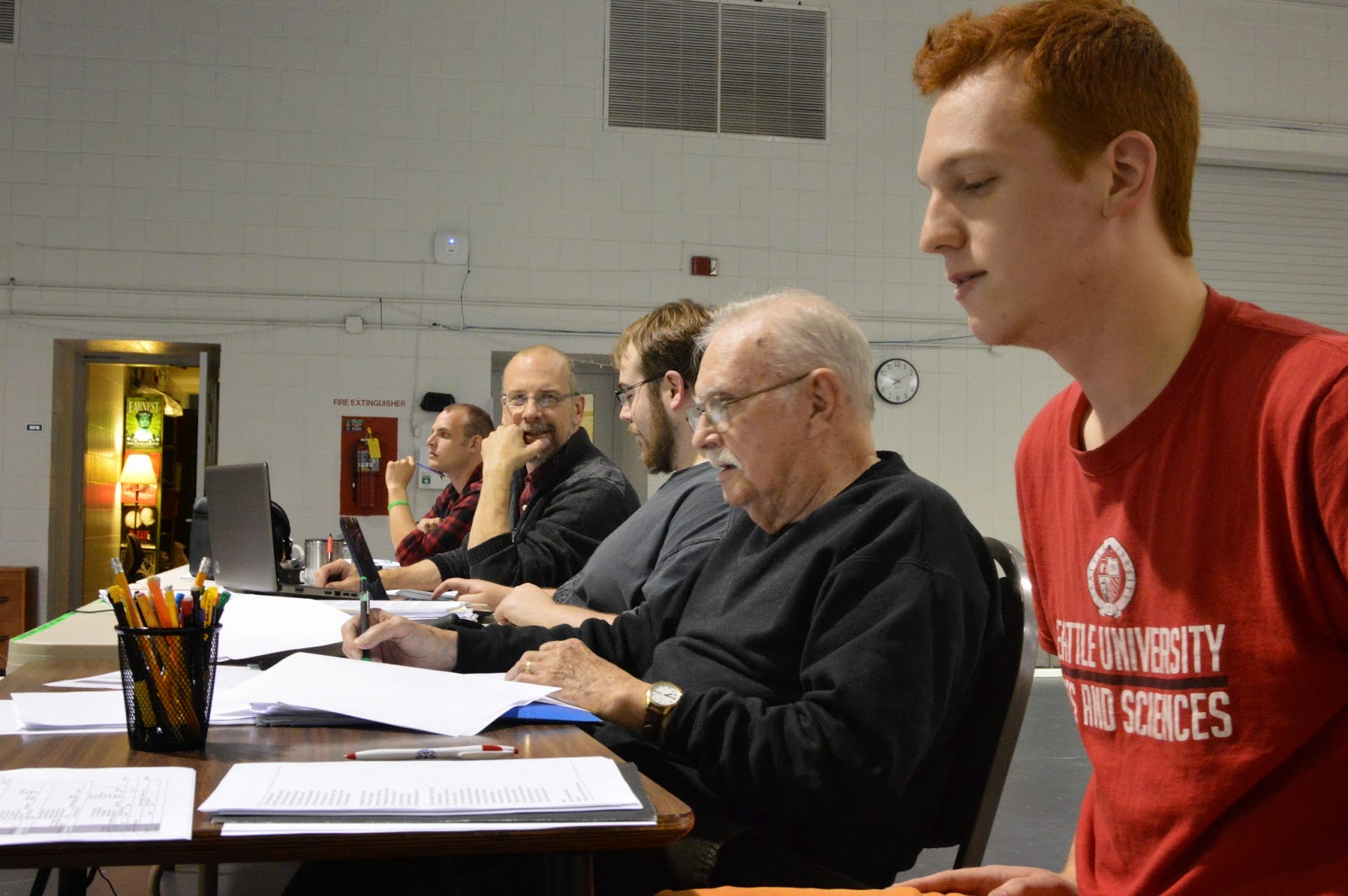
The collaborative team, including Dramaturg Jim Seay, Composer Jefferson Davis, Stage Manager A. J. O'Shea, Director Mark Hardiman, Assistant Director Shannon Murphy, and Lighting Design Student Tim Creason.

Dramaturg Jim Seay and Writer Enjoni West contemplating Eulalie.

A deep discussion between Director, Stage Manager, and Assistant Director regarding staging of a scene while Enjoni West and Jim Seay listen and make notes.

Assistant Director Shannon Murphy works hard to notate the discussion of the piece.
Wednesday, October 8, 2014
Introducing the Production, By August Roy
Below are some of the pictures from rehearsal over the last few weeks.


Approaching Poe: A Note From the Director On Collaborating With a Creative Team and Famous Text
I have long had an idea of dealing with Poe in performance in some way. That plan started with an idea of adapting works to tour high schools many years ago. It evolved in my thinking to an evening of Poe and then to a devised piece based upon the works of Poe, which was my intent with this project here.
We began just over two weeks ago after casting with a fair number of texts from people’s favorites list of poe short stories and poems. I used the ensemble, people I spoke to and my recollections of works I had read to form the foundation. These were copied and assembled. We broke our cast into two working teams, each team worked on a short list of texts. Our process began with reading the text then experimenting with ways to cast light--to open up and illuminate meanings within the text--with staging. In some cases text was broken up with a variety of speakers, in some cases there was a narrator of sorts and the text was performed. We worked on solving difficult problems with staging using huge pieces of fabric and actors.
After two weeks of rehearsal and intense discussions nightly (sometimes going until past 11PM) with the directorial team to clarify and solidify findings, we felt it was time that the directorial team assemble over two days and hone a general working text for the piece. It became clear that due to the quality of Poe’s writing, that the nature of the final text will be more dependant on the actual text of Poe than we at first may have considered. We had originally thought we might be creating some of our own verbally-expressed text. But, on examination and through some experimentation, it proved unnecessary when we looked at the bounty of writing Poe already provided.
The question then was, what was to be the form of the text? We had worked with and rough-staged various stories and poems and considered, what was their metaphoric structure? What was the tone and subject matter? Picking common forms, themes and ideas helped us derive a overall structure and sense of mood for a rough draft of a working script. This helped us reduce the amount of text we would use. I have always felt that the texts had a mystical aspect that was their central pull and had toyed with a ritual structure to the piece, however, we wanted a form that was in some way familiar but allowed a kind of metaphoric dissonance that would be both compelling and disturbing--similar to the way that Poe writes. Then, examining all the pieces in aggregate, we landed on an artistic and textual form that served the pieces: a mass (here meaning a service or ritual ceremony.)
As we head into tonight’s rehearsal we will be experimenting with a flow in mind, molding and shaping our staging while further winnowing down the text by focusing on what can be done and not spoken….
Subscribe to:
Posts (Atom)