Tuesday, May 26, 2015

Ineffectual Outlaws and Physical Comedy

Shakespeare presents outlaws (who are actually banished gentlemen) in a strange light, they are seen pleading with Silvia for their compliance, they fail at intimidating new strangers in the forest and immediately adopt Valentine as their leader. To make all this plausible, we have to enter into the illogical logic of clowning and slapstick that our Commedia-inspired production allows.


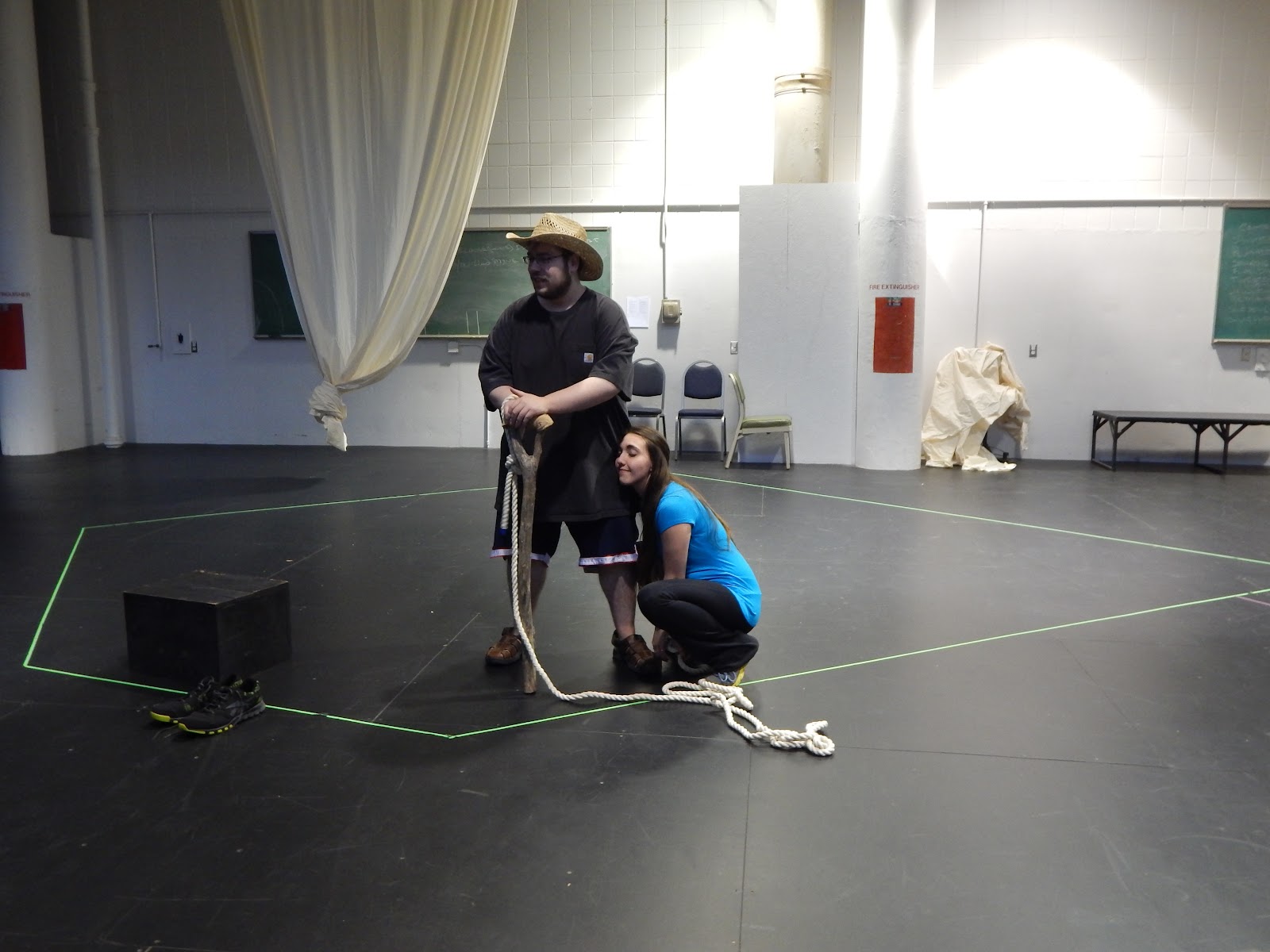
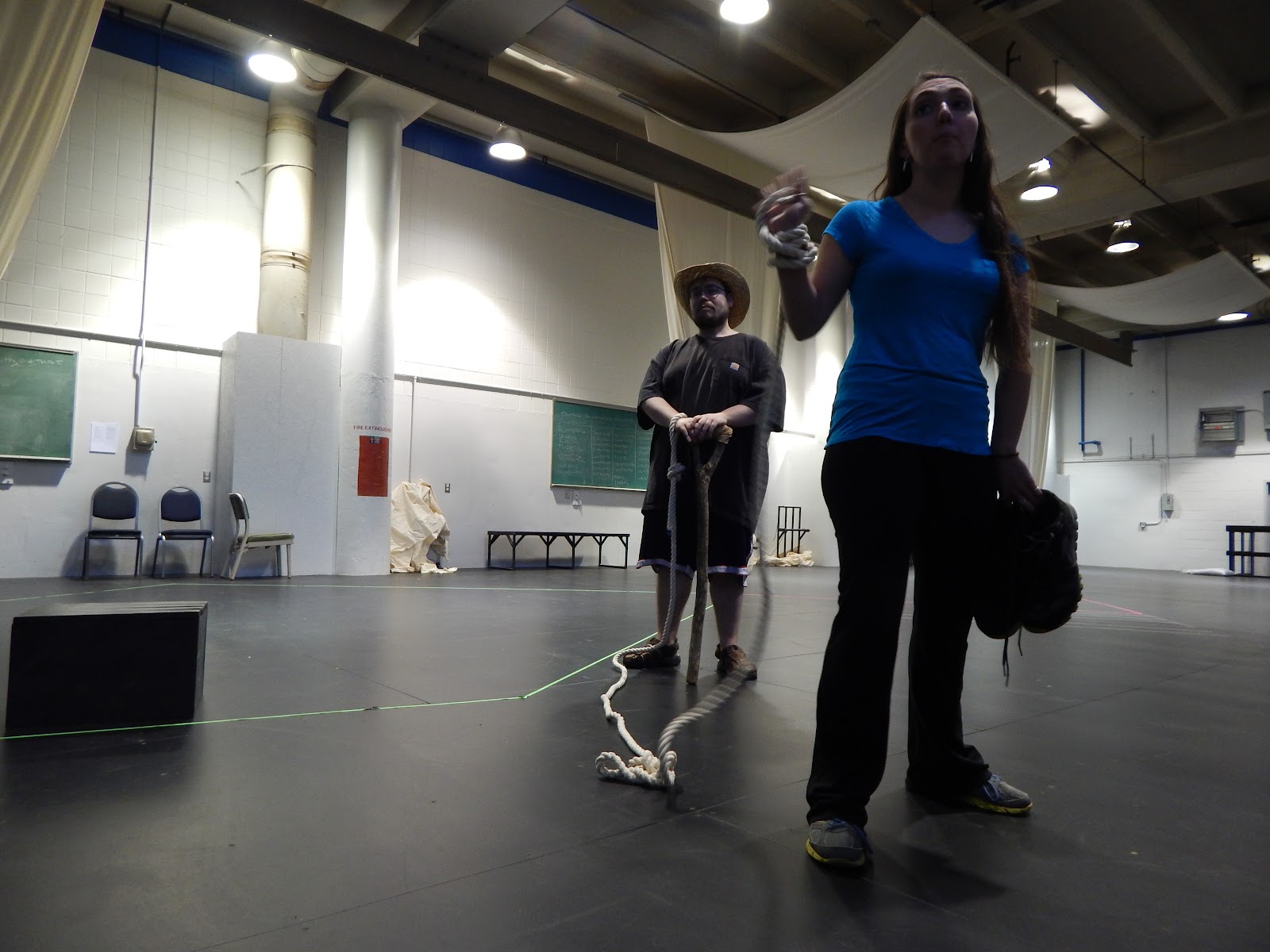
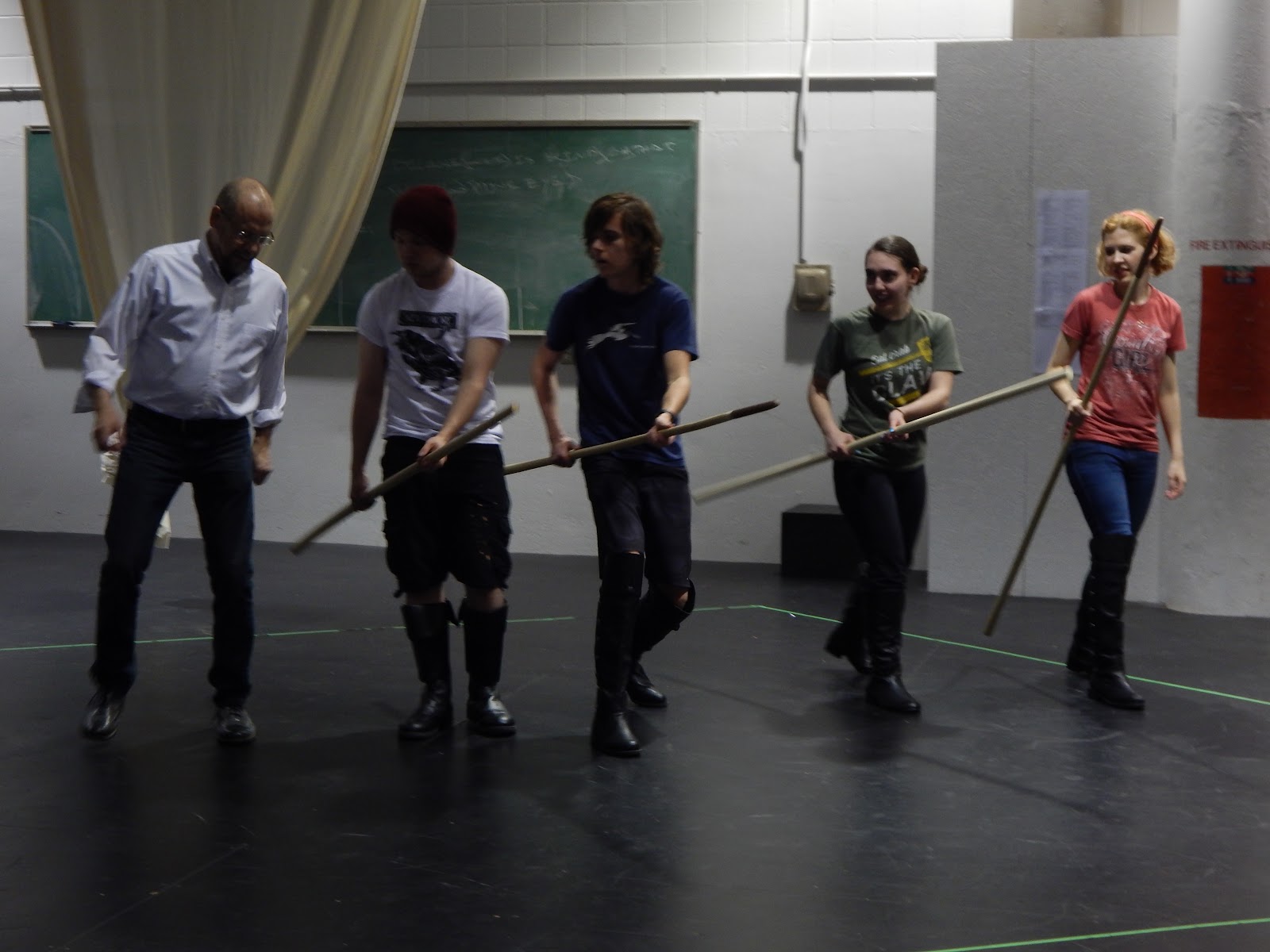
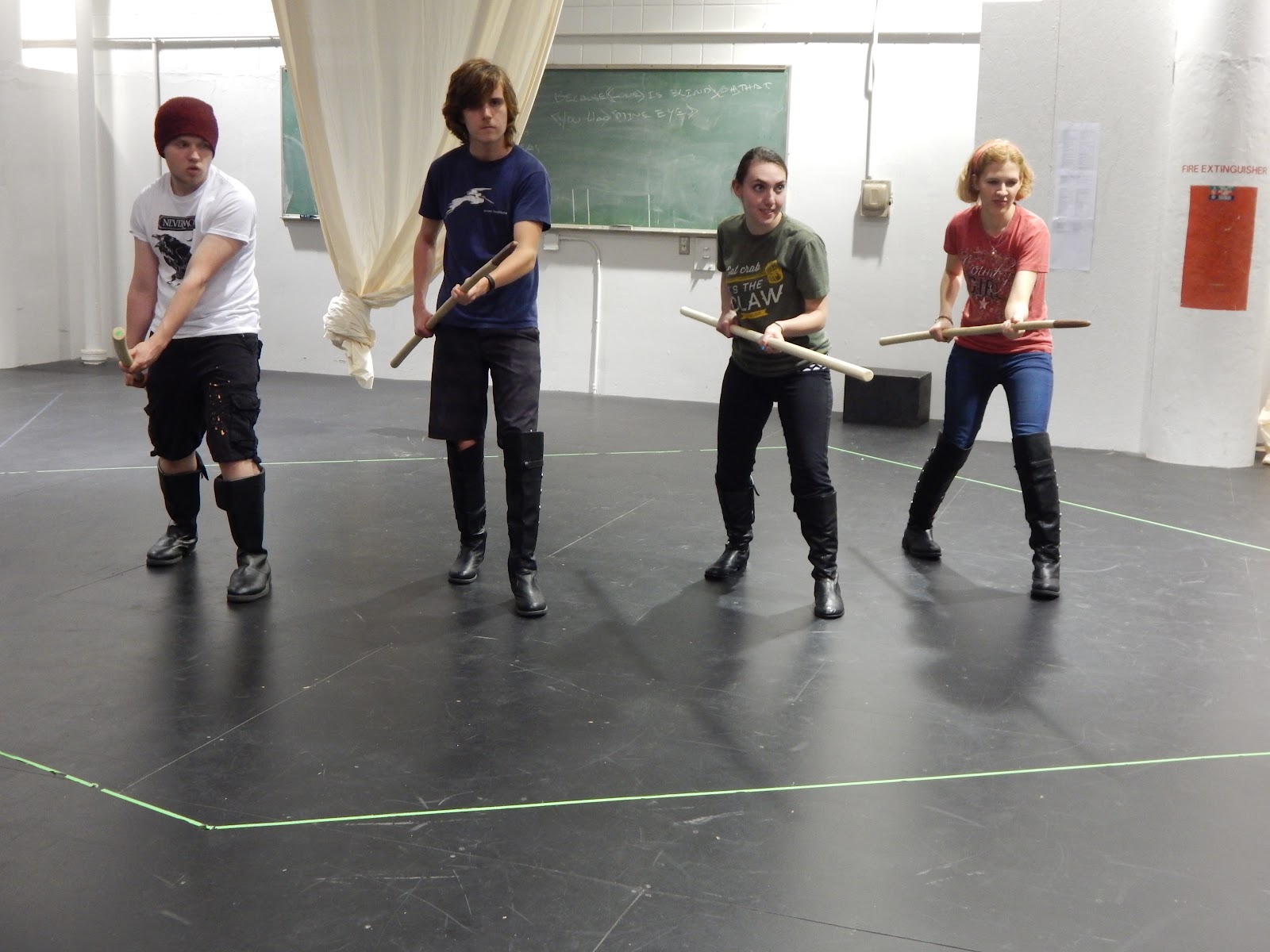
Here, director Hardiman without (quarterstaff) works with outlaws (Left to right) Ramsey Miller, Devon Swafford, Katie Steinhour, and Anne Reis on choreography for an attack sequence. Precision footwork and obstacles are set up to establish the comic structure, by using surprise and building tension through tight choreography.


The cast repeats sequences refining movements until everyone is performing the same footwork exactly the same way. This establishes a pattern that can later be broken when they fall into disarray.


Now enter Valentine (Ryan Heaton) and Speed (John Olmstead on Valentine’s back) they respond to the comic threat comically. Inevitably the tension is broken when Speed falls to the ground.

Lastly, we play on our own cross-gender casting by building on the fact that the outlaws may indeed have some women in their midst, playing men as the play establishes with Julia. This builds into an attraction of two of the outlaws for the noble Valentine and helps rationalize their hasty acceptance of Valentine as their leader.


In fact many people find themselves attracted to the noble Valentine, which helps us conceptually play on the themes of jealousy and foolish love and attraction that sit at the core of the play.

Monday, May 25, 2015

One of the wonderful things about Shakespearean plays is their sub plots. In this play, as in many commedia plots, one of the young lovers (innamorati) is set up or wooed by someone who is totally wrong or inappropriate for them. In the case of Two Gents it is the Duke who wants Thurio, to marry his daughter, Silvia.


Above Devon Swafford as Thurio, woos Silvia Lindsey Dixon.


Thurio is what in the later English Restoration would come to be called a fop. Fops are characters who are social climbers who have neither birth nor wealth sufficient to earn them their desired position in society. They are generally mocked by people of class because in their effort to be witty, gracious, elegant, brave they overstep and make fools out of themselves. Their over-the-top efforts make them laughable.


Often the fop loves someone who is out of their league and makes efforts to advance their cause, by impressing and wooing the intended love.

This often strikes us as funny as we all recognize the situation. Most people have loved where they are not loved and the more we press our suit, the more distant we become. We sometimes end up playing the friend of someone we deeply love just to be close to them. This common situation is both humorous and at times strikes a note of pathos.

Sunday, May 24, 2015

Special Characters: Launce and Crab

Two Gents presents us with some unusual problems that we solve through creative ways. First there are oversized characters, many of which are drawn from Commedia dell’arte, the Italian form of comedy popular throughout the renaissance in Europe. These are given an unusual spin in England when Shakespeare combines them with what was probably a dog act. Though there is no recorded performance of Two Gents in Shakespeare’s time, one can assume that Shakespeare had a comic actor who had a trained dog in mind as a paring with the character, Launce.


We had a terrific opportunity to elevate the character using the ideas of Commedia to a human/masked/animal character. This allows us to have characters work in a precise and improvisational manner and develop much of the physical comedy required, by calling on the unique loving relationship people have with their pets, many of whom behave badly but are adorable in doing so. Here we see a rehearsal shot of A.J. O’Shea as Launce and Katie Steinhour as Crab the dog.


The relationship between Crab and Launce presents myriad possibilities, plus props come into play in various ways. Leashes present many comic opportunities, causing their masters to trip, and other variations, also dog’s tendency to steal objects, fetch them and want to play with them are all opportunities we explore.

Saturday, May 23, 2015

Fight Choreography for Two Gents

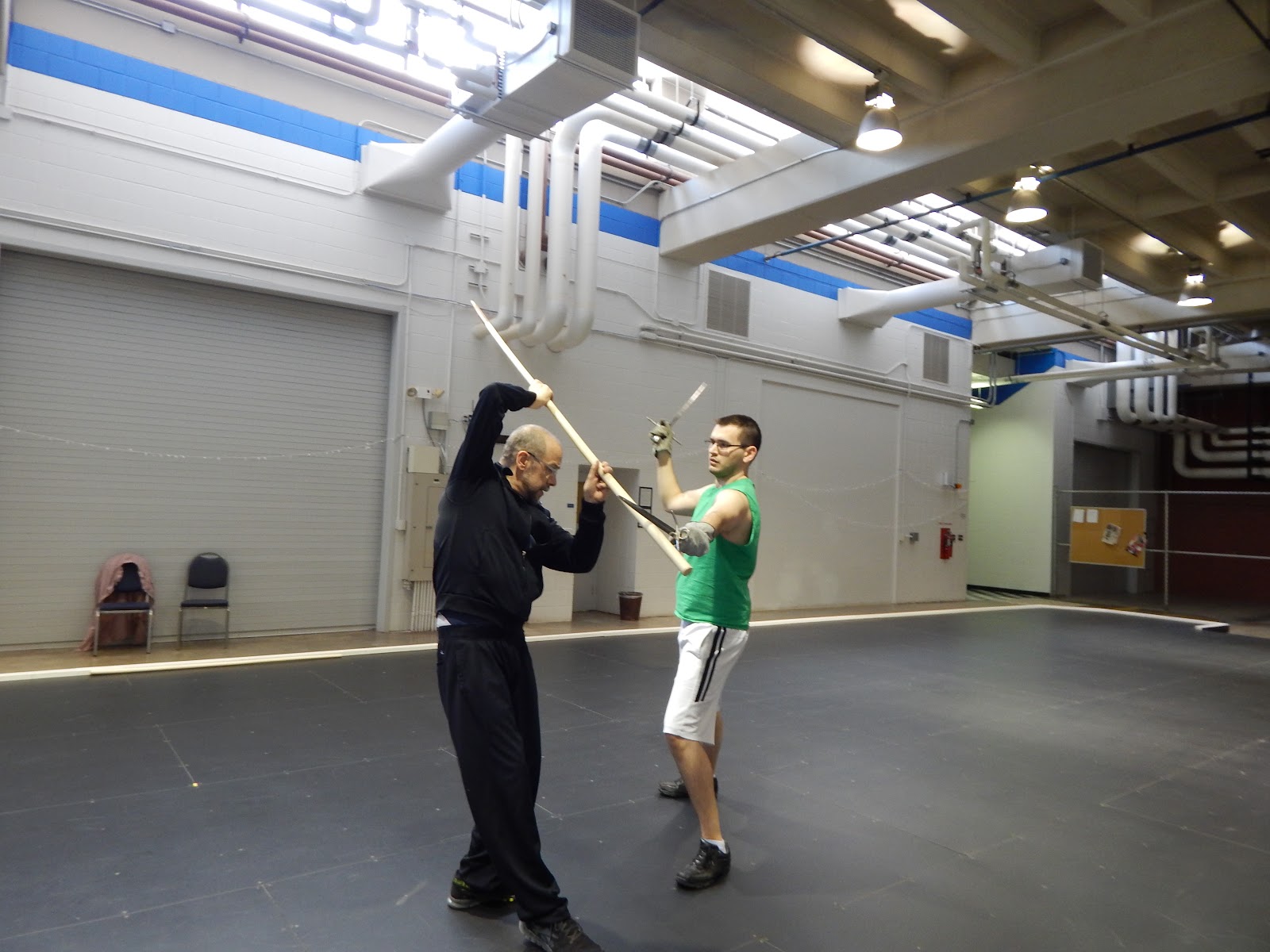
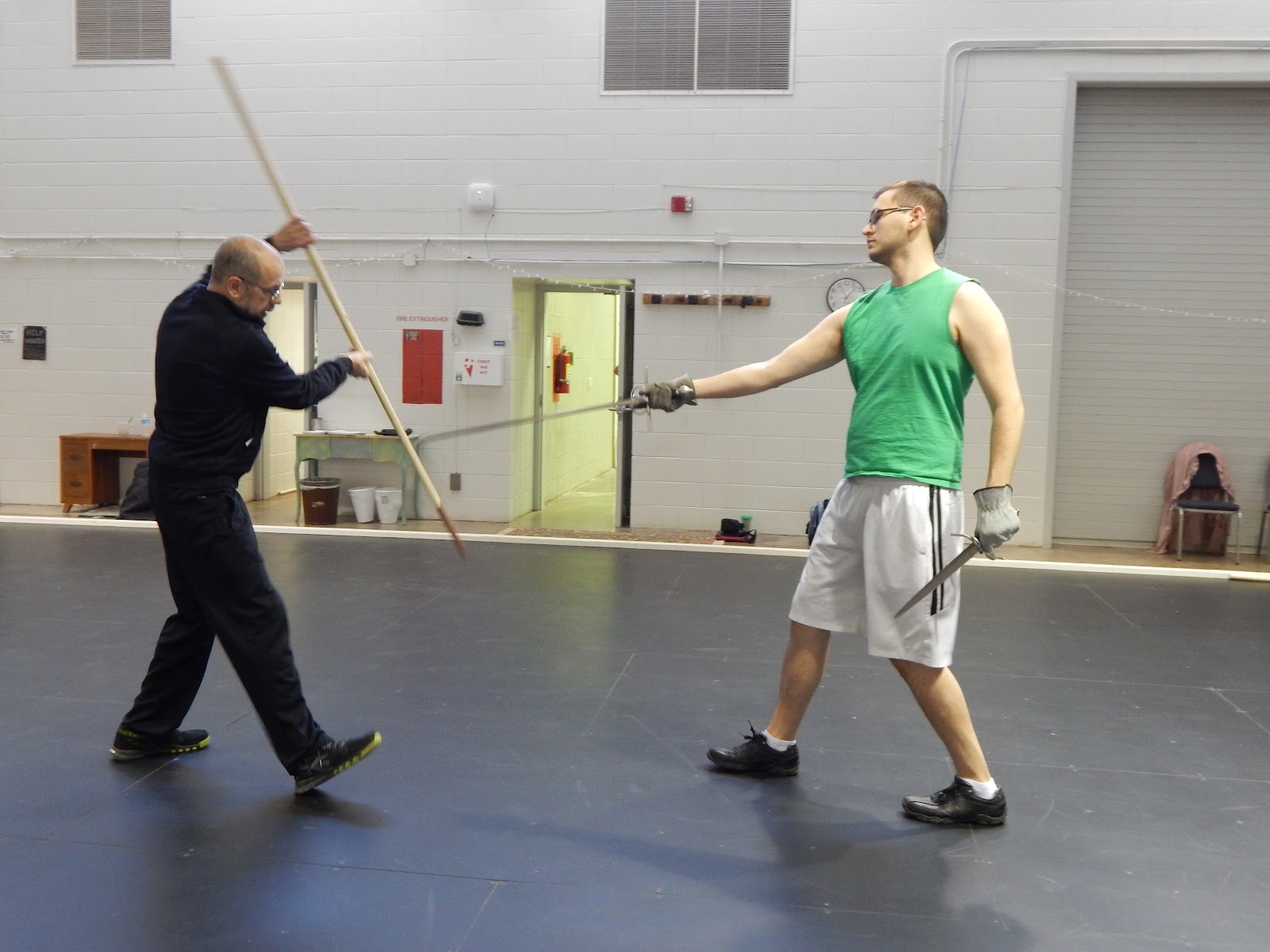
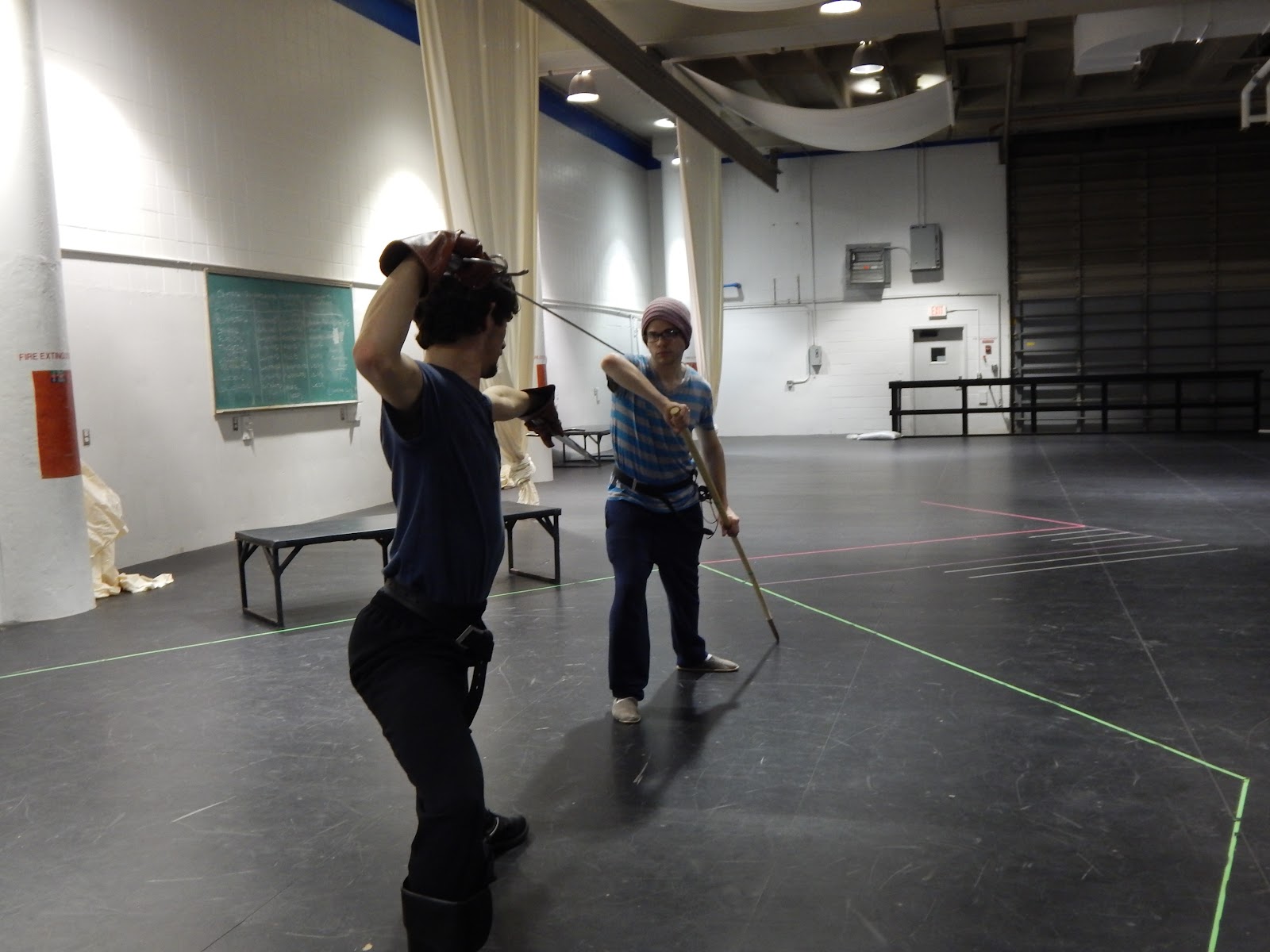
Choreographing the final fight in Two Gents: Director Hardiman works with Brett Wands to build the exciting climax of the show. The weapons chosen are two unlike weapon forms: Rapier and Dagger and Quarterstaff. This is decided upon because Valentine, having been banished, had to seek refuge in the forest, where he would have limited access to weapons. Proteus comes from the court of the Duke and is armed with the weapons of a gentleman. This characterizes AND highlights the contrasts of the natural condition in the forest against the calculated Machiavellian world in the court.

Brett wands and Mark Hardiman choreograph the final fight for Two Gents. The initial moves are sketched out and developed.

Unusual moves are required because of using such different weapon styles. A sword is about 3 feet long while the Quarterstaff is 6 feet long. This makes many strategic choices for the characters.

DSCN0203.jpg

Here the size difference in the weapons is particularly clear. Hardiman is parrying an attack made by Wands while advancing into the attack, which speaks to the desperation of the character.

Finally, the actors in the scene are taught the choreography and it is refined and adapted for their particular body types, character motivations and combat experience.

Not only do we pay attention to the story, safety, the motivated choreography, but artistic considerations are made that make the fight visually appealing from various sides of the house. This is done so that audience members can appreciate the fight both dramatically and aesthetically no matter where they sit in the audience.

Sunday, March 15, 2015

Beginning Fight Work for Two Gents

Greetings folks! We have started to rehearse, and we are now up on our feet. What does that mean? It means we make interesting subjects for pictures! Here are some of the pictures from tonight's fight work. You will see some familiar faces from our last productions: The Shadows of Edgar Allan Poe, and Your Swash Is Unbuckled, among others. Our lovely experienced fighters helped us choreograph this fight between Proteus and his manservant Sebastian (who is his forsaken lover, Julia, in disguise) and outlaws who have captured his current object of desire, Silvia.

Proteus and Sebastian (played by Nick Snyder and August Roy) surprise the outlaws.

Silvia (Lindsay Dixon) takes charge of the fight, attempting to escape.

Sebastian is thrown back my Silvia's mighty struggle.


Silvia is captured again, and Proteus carries her off, while Mark Hardiman (director) looks on to check safety. 

Friday, February 27, 2015

Commedia dell'arte from our dramaturg, Jim Seay

What is Commedia dell' Arte. You may understandably ask. The simple answer is that it is a form of improvisational theatre that began in Italy in the 16th Century and spread out from there, The performers (they are not called actors!) have a scenario (in outline form) and a performing troupe would generally have about a week to improvise an entire performance from a stage direction that may well read something like “Pedrolino and Oratio enter and do something funny,” or, perhaps “Everyone comes on stage and resolves everything happily,” Since the entire performance in improvisation and comedy, people not familiar with actually performing in the Commedia dell' Arte generally thin it is quite easy to do, Nothing could be further from the truth. Actually this pair of features (improvisation and comedy) make it one of the most difficult forms of western theatre, The performers (not the playwright) write the dialogue. Which means that they must have the wit and imagination of a playwright. Since the action and dialogue are improvised, there are no cues and timing is much more important than in conventional theatre, Since the performance is also comedic, the timing requirements are unforgiving. In conventional theatre the actor can be semi-tragic and the audience will still feel it, or he can be semi-funny and they will still laugh, not true in the Commedia dell'arte.

The characters in the Commedia are stock, but they usually include the following:

  • Pantalone:(who is a Merchant of Venice [not to be confused with Antonio in Shakespeare's play of that name), He is rich, greedy and miserly])
  • Gratiano who is a pedant, usually a lawyer, PLEASE NOTE: since both Pantalone and Gratiano are old men, they are referred to as vecchi, which is Italian for “old male characters.”
  • Pedrolino & Arlecchino: who are servants of the old men and are known, collectively, as Zanni
  • In addition to these stock characters, most Commedia dell' Arte performances will have the amorosi (lovers)
  • Il Capitano,(a Spanish soldier who is full of bluff and bluster but actually afraid of his own shadow.) along with a section of villains and others.

The Commedia dell' Arte, despite being an Italian art form, has had a notable influence on English.

Here are a few:

  • The word “pants” comes from *guess where?) Pantalone (via pantaloons which are the type of  dress that Pantalone wore on stage. Before the Comedia,they were called “Venetian breeches.)
  • The word, “zany” comes from (you guessed it!) the two zanni,Doesn't this give you a pretty good idea of how they behave on stage?
  • Harlequin is the French version of Arlecchino.

So much for the small influences – now let's go for the big ones! Let's just mention one from Scenarios of the Commedia dell'arte, a translation of Flaminio la Scala's collection of scenarios, published in  1611, taken from the “argument” (or introduction) of the play: “There lived in Florence two gentlemen called Pantalone and Gratiano. They were old men of noble families, and bore a long hatred for each other ... Oratio [Pantalone's son] had fallen in love with Isabella. Daughter of his enemy [Gratiano] ... [Isabella] too, with the help of a physician, a potion which would put her into a death-like sleep.... ”Now does that sound familiar? And we thought Willie-the-Shake swiped R&J from the Greeks (Pyramus and Thisbe) Except Shakespeare turned it into a tragedy, where this Commedia scenario was actually a set-up for a comedy. In point of fact, many of Shakespeare's plays (including Two Gentlemen of Verona} share so many points of similarity with many of the scenarios of the Commedia dell'arte that it seems pretty likely that ol' Will had seen them or at least was familiar with them! What was that Brendan Behan said? “Talent plagiarizes. Genius steals.”
Thursday, February 26, 2015

Opening May 29 in collaboration Theatre in The Park LLCC Theatre will be doing a Commedia dell'arte inspired version of Shakespeare's Comedy, The Two Gentlemen of Verona.


Commedia (as it is known) was a renaissance improvised comedy that used broad physical comedy. It is from Commedia that we have acquired the term "slapstick.". The slapstick is a wooden bat of sorts that is thin and flat. It has two parallel boards so that when it is used to strike someone it makes a loud clapping sound.

The illustration above depicts Harlequin (or Arlecchino) one of the clownish characters in Commedia holding a slapstick.